Lines & Boxes (Dots and Boxes)
A grid of dots, two players, one line at a time. Dots and Boxes looks like the game you doodled at the back of a notebook, and it is. It is also one of the sneakiest strategy games ever played on paper, with a trick at its heart that most people never learn.
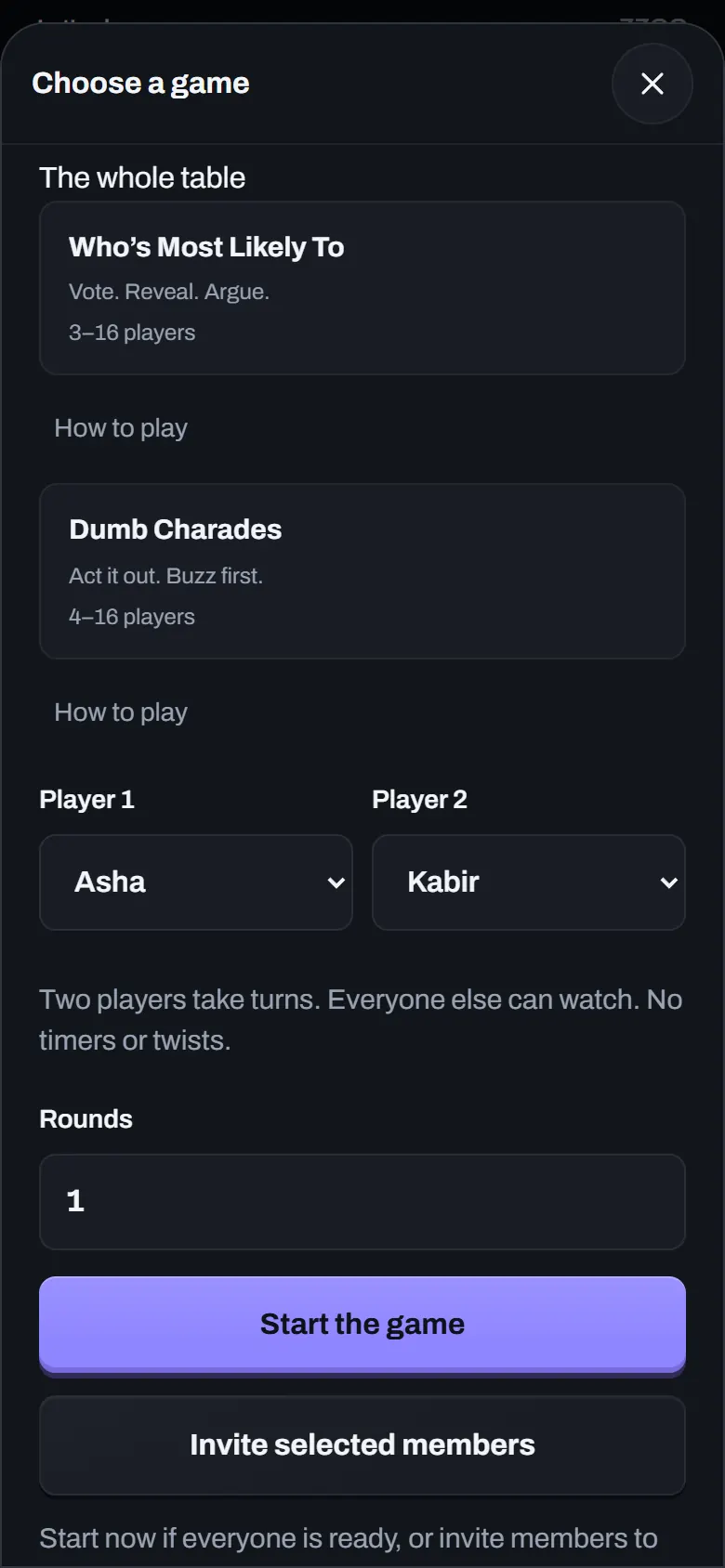
We call our version Lines & Boxes. Two players take turns on their phones, everyone else in the crew can watch, and the app keeps every box and every point straight.
Create a crew and playAt a glance
| Players | 2 (the rest of the crew watches) |
|---|---|
| Board | 4 by 4 dots, 9 boxes |
| Turn | No timer. Take your time |
| Match | 1 to 5 rounds |
| You need | Two phones, or one phone passed between a parent and a kid |
How to play
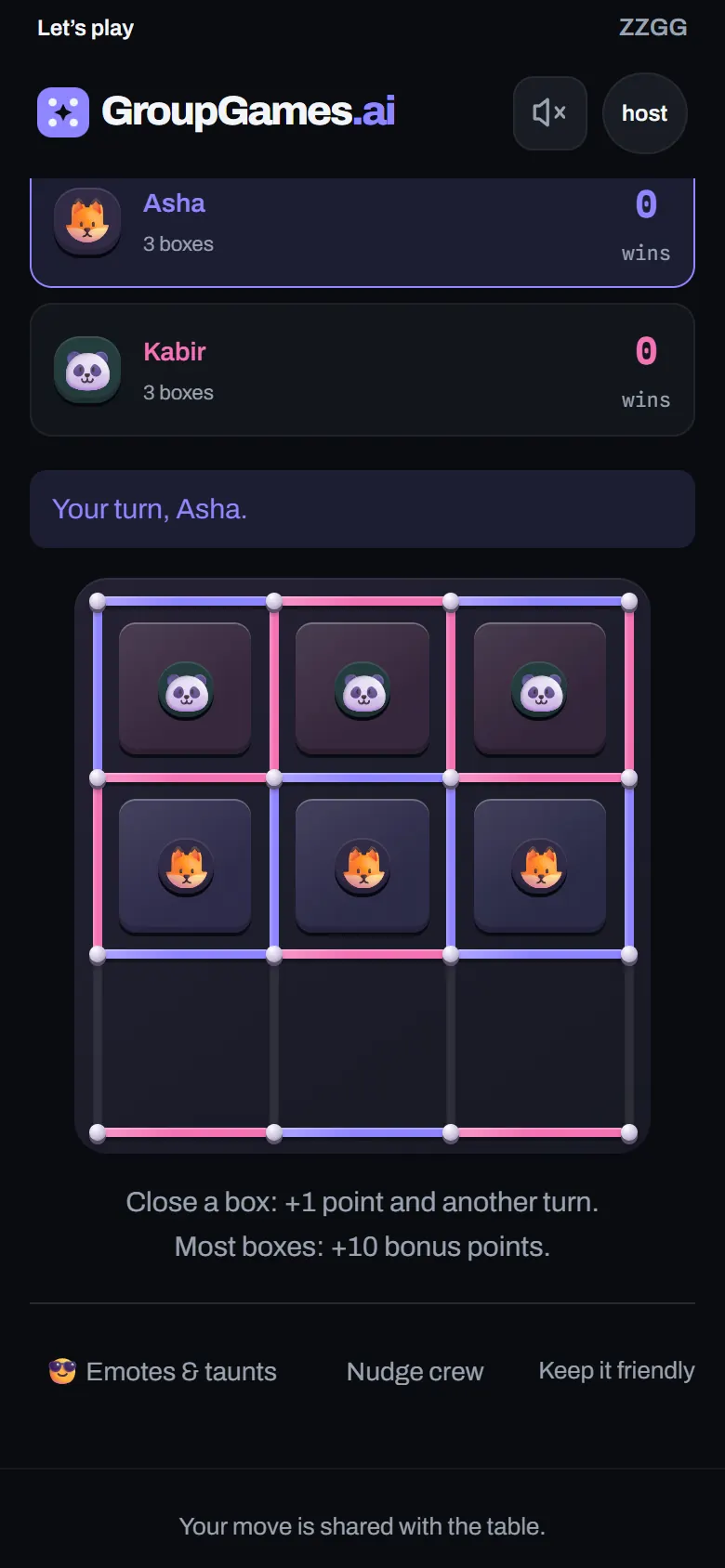
- Players take turns drawing one line between two neighbouring dots, across or down.
- If your line completes the fourth side of a box, you claim that box.
- After claiming a box you must draw another line. Keep going as long as you keep closing boxes.
- One line can close two boxes at once.
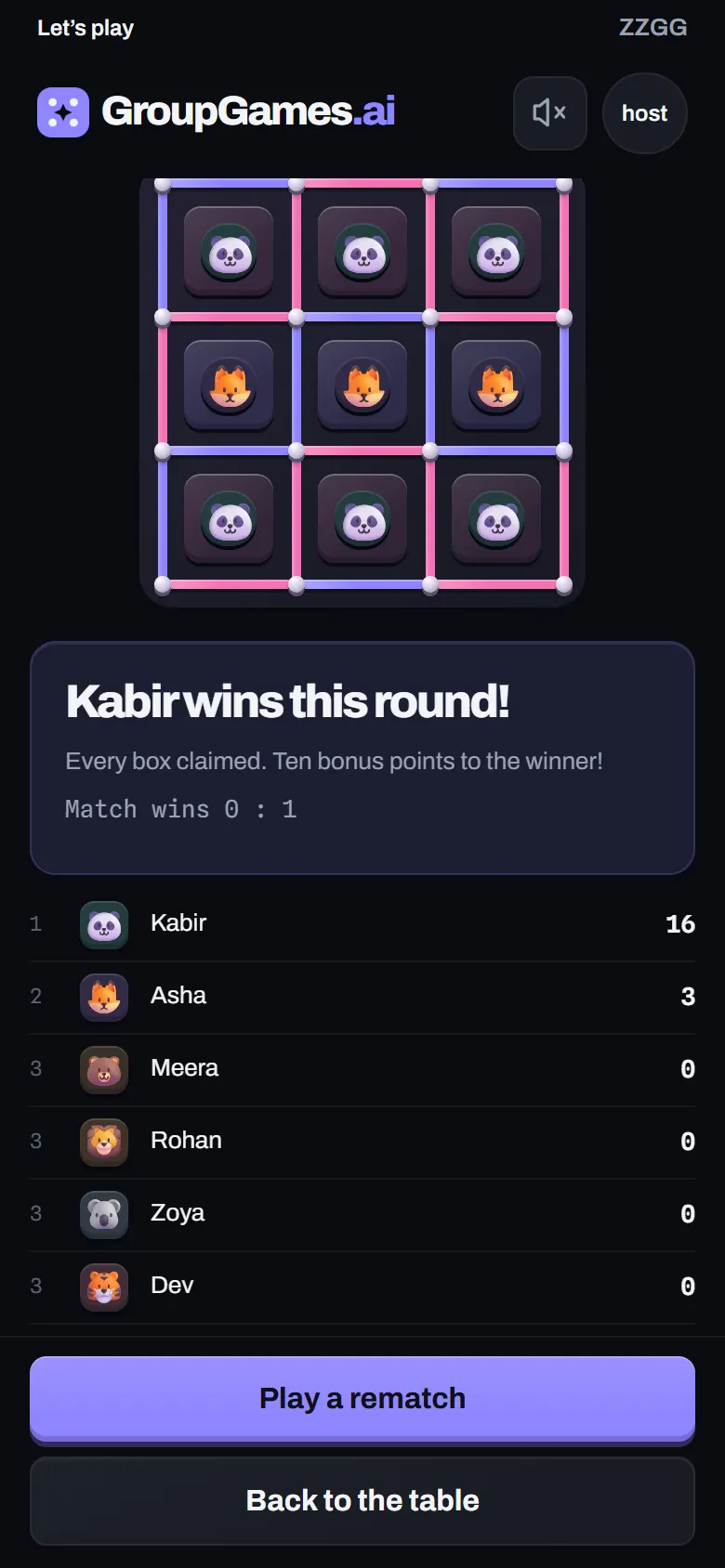
- When every line is drawn, the player with more boxes wins the round.
How it works in GroupGames.ai
Scoring
- Each box you close is worth 1 point.
- The player with the most boxes at the end of the round also gets 10 bonus points.
- Points count toward the crew’s all time leaderboard, next to the party games.
What makes ours different
- Two phones, one board. Each player moves on their own phone. The server checks every line, so nobody can draw out of turn and a dropped connection never loses the board.
- Spectators. The whole table can watch the endgame unfold on their own screens.
- Kids welcome. A child can play on a parent’s phone. The app asks you to hand it over when it is their move.
- Crew history. Wins and scores stay with your crew from one night to the next.
Strategy: how to win at Dots and Boxes
Never draw the third side of a box early. It hands your opponent a free box and usually another move.
Count the chains. Late in the game the board breaks into chains: rows of boxes where drawing any line gives all of them away. The player who is forced to open the first long chain usually loses.
Learn the double cross. When your opponent opens a long chain, take every box except the last two, then draw the line that leaves those two for them. You give up two boxes, but they must then open the next chain for you. This single move wins most games between beginners and improvers.
Play for control, not boxes. Giving away a few small boxes early is fine if it means you control who opens the long chains later.
Ways to play
Best of five. Set the match to five rounds. The opening player swaps each round, so the result is fair.
Teach it at the table. Play one round with a beginner while the crew watches. Spectators pick up the chain trick fast when they see it happen.
Parent and child. Add your child as a kid seat and play on one phone. The app tells you when to hand it over.
Common mistakes
- Grabbing every box offered. Taking all the boxes in a chain can leave you forced to open the next, bigger one.
- Filling the board randomly early on. Early lines decide how the chains form later. Try to keep an odd or even number of long chains in your favour.
- Forgetting you must move again. After you close a box you have to draw another line, and that line can give a chain away.
A short history
The French mathematician Édouard Lucas, famous for his work on number theory and the Tower of Hanoi puzzle, published the game in the late 19th century under the name la pipopipette. Since then it has picked up names all over the world: dots and dashes, the game of dots, boxes and pigs in a pen. It is simple enough for children and deep enough that the mathematician Elwyn Berlekamp wrote a whole book on expert play, The Dots and Boxes Game: Sophisticated Child’s Play, published in 2000.
FAQ
How many players can play Dots and Boxes? The classic game is for two. In GroupGames.ai two players compete and anyone else in the crew watches.
Do you get another turn after completing a box? Yes. Every time you close a box, you must draw another line.
Who wins Dots and Boxes? The player with the most boxes when all lines are drawn.
What is the chain rule? A rule of thumb for the endgame: count the long chains of boxes and make sure your opponent is the one forced to open them. The player who has to open the first long chain usually loses.
What is a double cross? A move that closes two boxes with one line. Deliberately leaving a double cross for your opponent is the key trick for keeping control of the game.
What size board is best? Beginners enjoy small boards. Our 4 by 4 dot board with 9 boxes keeps each round short enough for a party but still leaves room for real strategy.
Is Dots and Boxes a game of luck? No. There is no luck at all. Every outcome comes from the players’ choices.