Memory Match
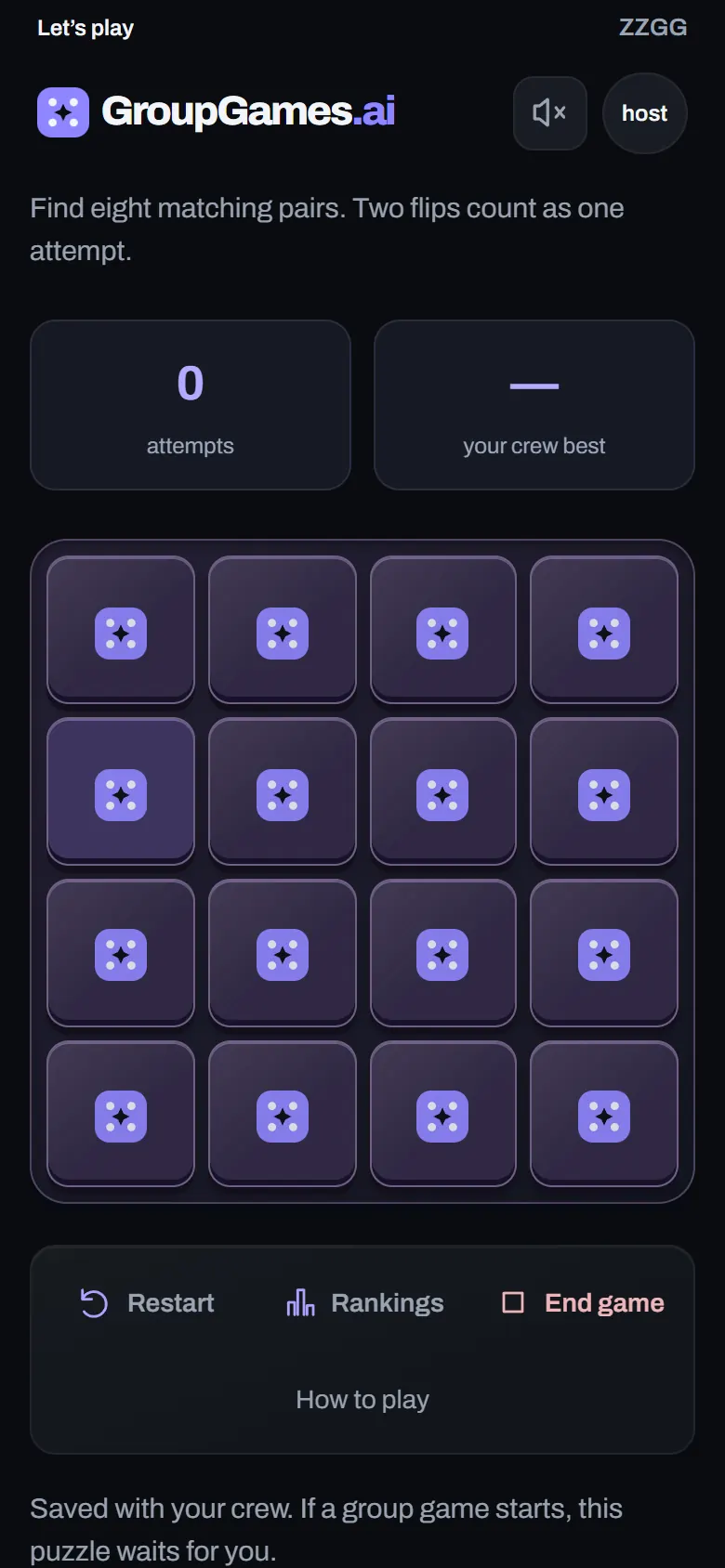
Sixteen cards face down. Flip two. If they match, they stay. If not, they flip back, and you had better remember where they were. Memory Match is the pairs game children learn first and adults still cannot resist.
Play it on your own in seconds, with no sign up and no room. Or play it inside your crew between party games and see who has the sharpest memory at the table.
Play Memory Match nowAt a glance
| Players | 1 at a time, with personal and crew bests |
|---|---|
| Cards | 16 cards, 8 pairs |
| Goal | Find every pair in the fewest attempts |
| Timer | None. Play at your own pace |
| You need | Any phone or computer. No account |
How to play
- All cards start face down in a grid.
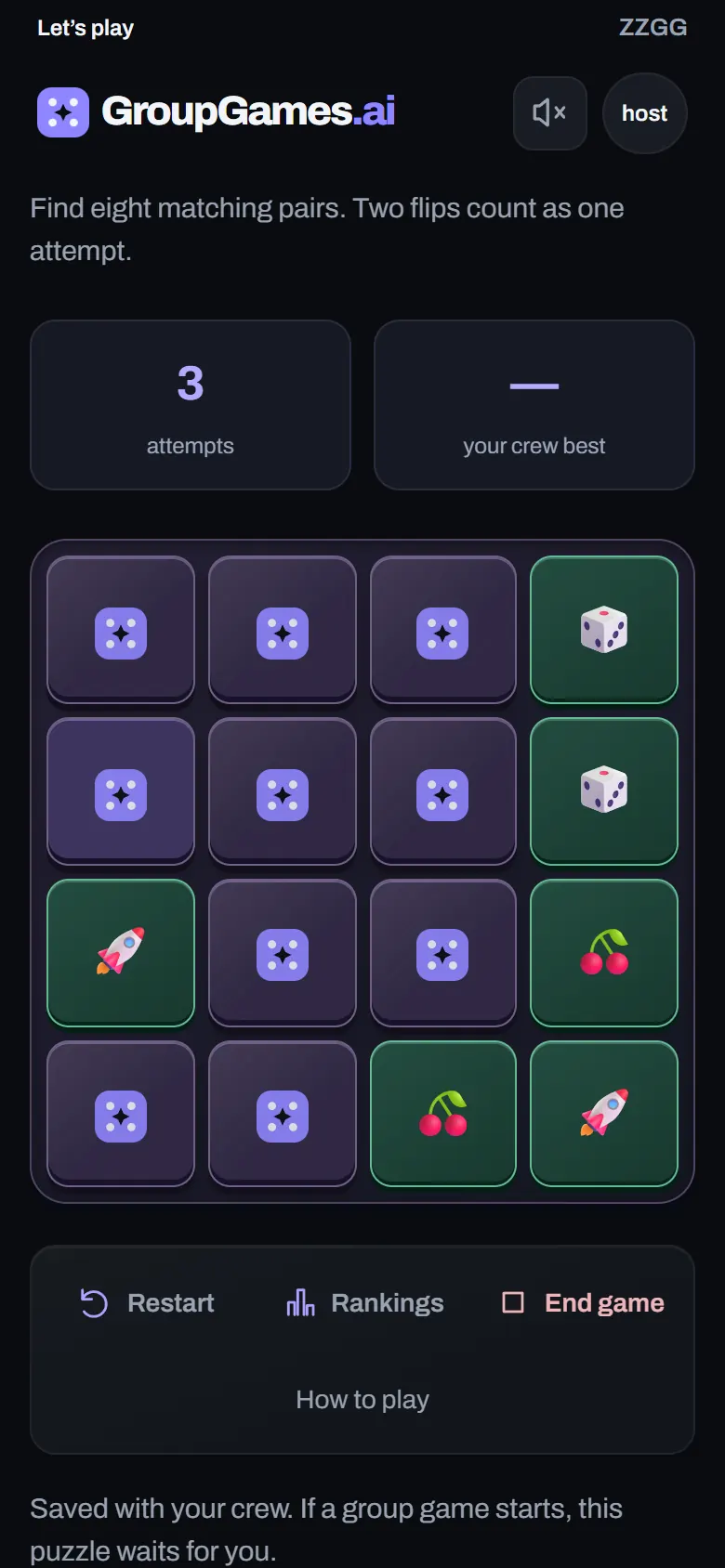
- Flip any two cards. That is one attempt.
- If the two cards match, they stay face up.
- If they do not match, you get a moment to look, then both flip back.
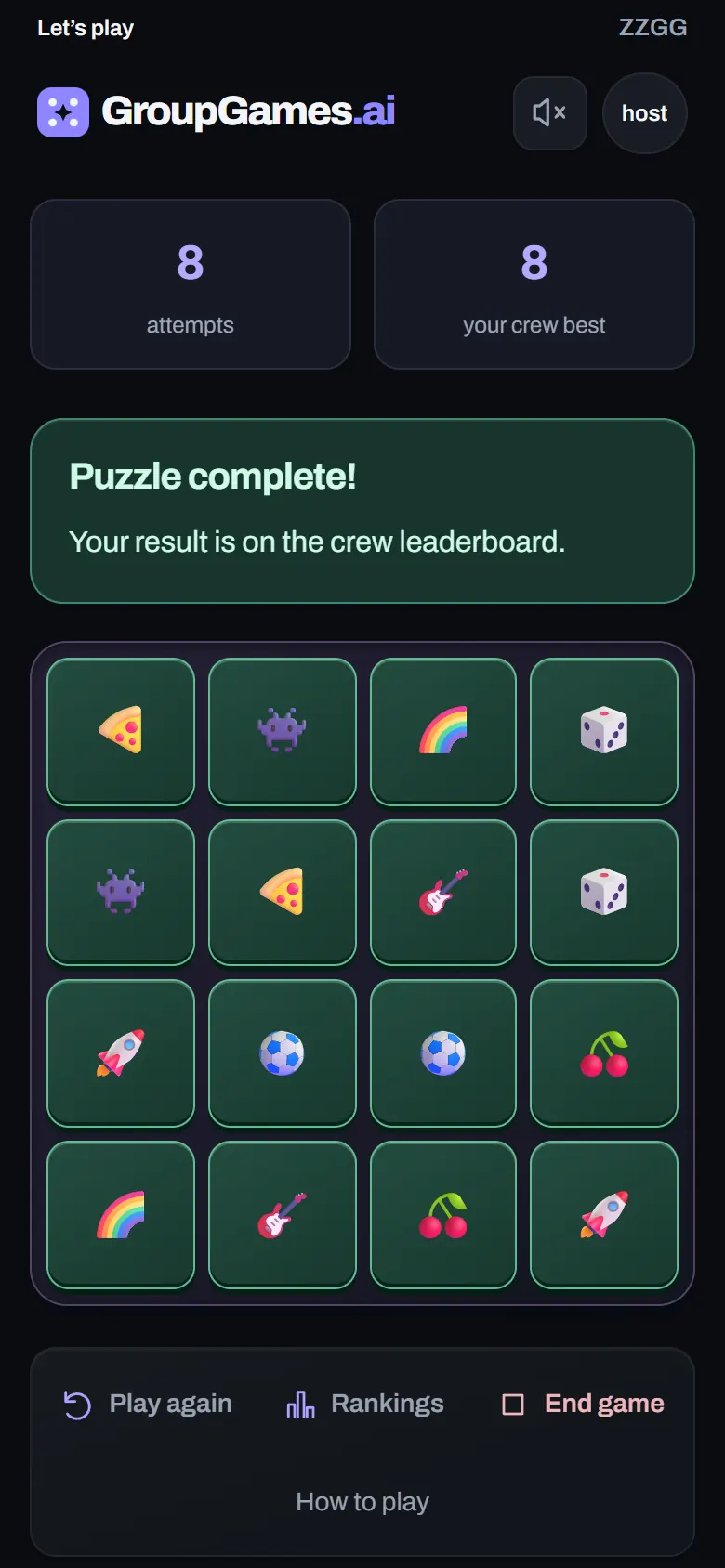
- Keep going until every pair is found.
- Your score is the number of attempts. Fewer is better.
How it works in GroupGames.ai
What makes ours different
- Instant to play. No room, no login, no download. Your progress is saved in your browser, so you can close the tab and carry on later.
- Crew bests. Inside a crew, Memory Match becomes a friendly competition. Only finished games count, so nobody can post a half score.
- Private boards. In a crew, your cards are yours. Nobody else can see your layout.
- Challenge your crew. After a finished game, send your score to the group and dare them to beat it.
Tips for a better score
Scan in a pattern. Work row by row. A fixed pattern makes positions far easier to remember.
Flip the unknown card first. If you already know where one card of a pair is, open a new card first. If it matches something you remember, you get a free pair.
Say it in your head. Naming each card and its spot, like “star, top left”, helps it stick.
Do not rush the reveal. When two cards do not match, take that moment to lock both positions into memory.
A perfect game, finding every pair without a single wasted attempt, takes 8 attempts. It needs luck as well as memory, so beating your own best is the real challenge.
Ways to play
Beat your best. The simplest challenge: keep lowering your attempts.
Crew leaderboard. Everyone in the crew plays their own shuffled board. Finished games go on the crew board, and the lowest attempts wins.
Quiet time for kids. Memory Match is calm, has no timer and no reading, which makes it a good hand me down game while the grown ups finish dinner.
Warm up. One quick board before a party game gets everyone’s attention switched on.
Common mistakes
- Flipping at random. Without a pattern, positions blur together fast.
- Flipping a known card first. Open the unknown card first, then decide.
- Rushing after a miss. The short look after a mismatch is the most valuable moment in the game.
Why people love it
Memory Match is one of the few games that is equally fair for a six year old and a grandparent. There is nothing to read, no reflexes to test and no rules to argue about. Children often beat adults at it, which makes it a favourite in families. It is also calm. With no timer and no opponent waiting, it is a good way to reset between louder party games.
A short history
The pairs game goes by many names: Concentration, Pelmanism, Pairs, Pexeso and Match Up. It was played with ordinary playing cards long before it had a box of its own, although no one knows when it began. In 1958 an American television quiz show called Concentration built a whole format around it and ran for 15 years. The following year a German publisher released a dedicated picture card edition based on a set of homemade cards, and it became one of the best known family games in the world. Teachers still use it to build concentration and recall.
FAQ
How many pairs are in Memory Match? Eight pairs, sixteen cards.
What is a good score? Eight attempts is perfect and needs a lot of luck. The best measure is your own record: aim to beat your personal best.
Is there a time limit? No. Your score is attempts, not time.
Can I play Memory Match without an account? Yes. Open the solo page and play. Your best is saved in your browser.
Is Memory Match good for kids? Yes. It is simple, has no reading, and helps young players practise attention and memory.
What is the difference between Memory and Concentration? They are the same game. Concentration and Pelmanism are older names for matching pairs of face down cards.
Can I compete with friends? Yes. Play inside your crew and your finished scores appear on the crew leaderboard.
Related games
Number Slide · 2048 · Hangman