Number Slide (sliding puzzle)
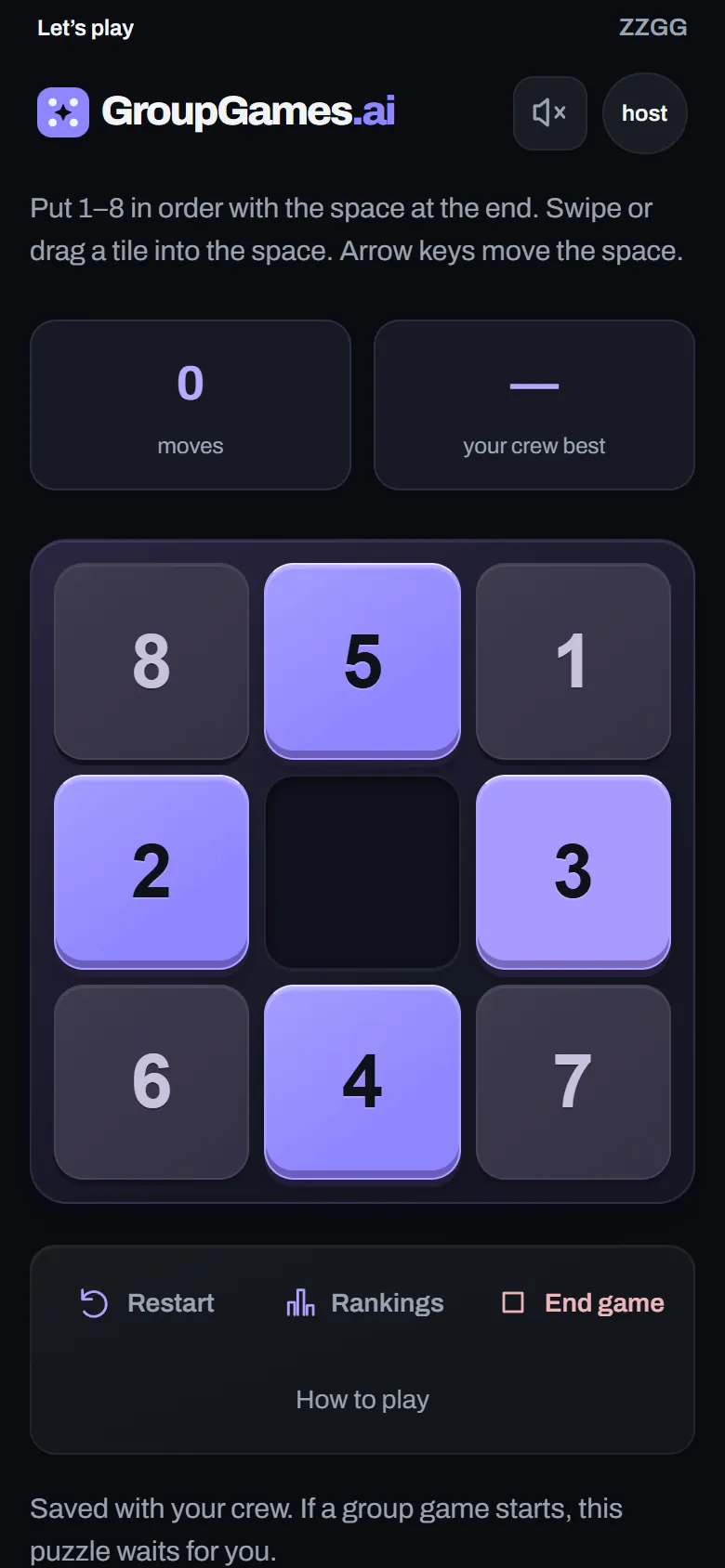
Eight numbered tiles, one empty square, and a scramble. Slide the tiles back into order from 1 to 8. Number Slide is the pocket puzzle that has been living in toy boxes and Christmas crackers for over a century, now on your phone.
Play it on your own with no sign up, or inside your crew to see who can solve it in the fewest moves.
Play Number Slide nowAt a glance
| Players | 1 at a time, with personal and crew bests |
|---|---|
| Board | 3 by 3: tiles 1 to 8 and one space |
| Goal | Put the tiles in order in the fewest moves |
| Timer | None |
| Controls | Swipe, drag, tap or use the arrow keys |
How to play
- The tiles start shuffled with one empty square.
- Slide any tile next to the empty square into it.
- Keep sliding until the tiles read 1 to 8 in order, row by row, with the space in the bottom right corner.
- Your score is the number of moves. Fewer is better.
How it works in GroupGames.ai

What makes ours different
- Always solvable. Many homemade and printed puzzles can end up impossible. Ours are shuffled by real moves, so a solution always exists.
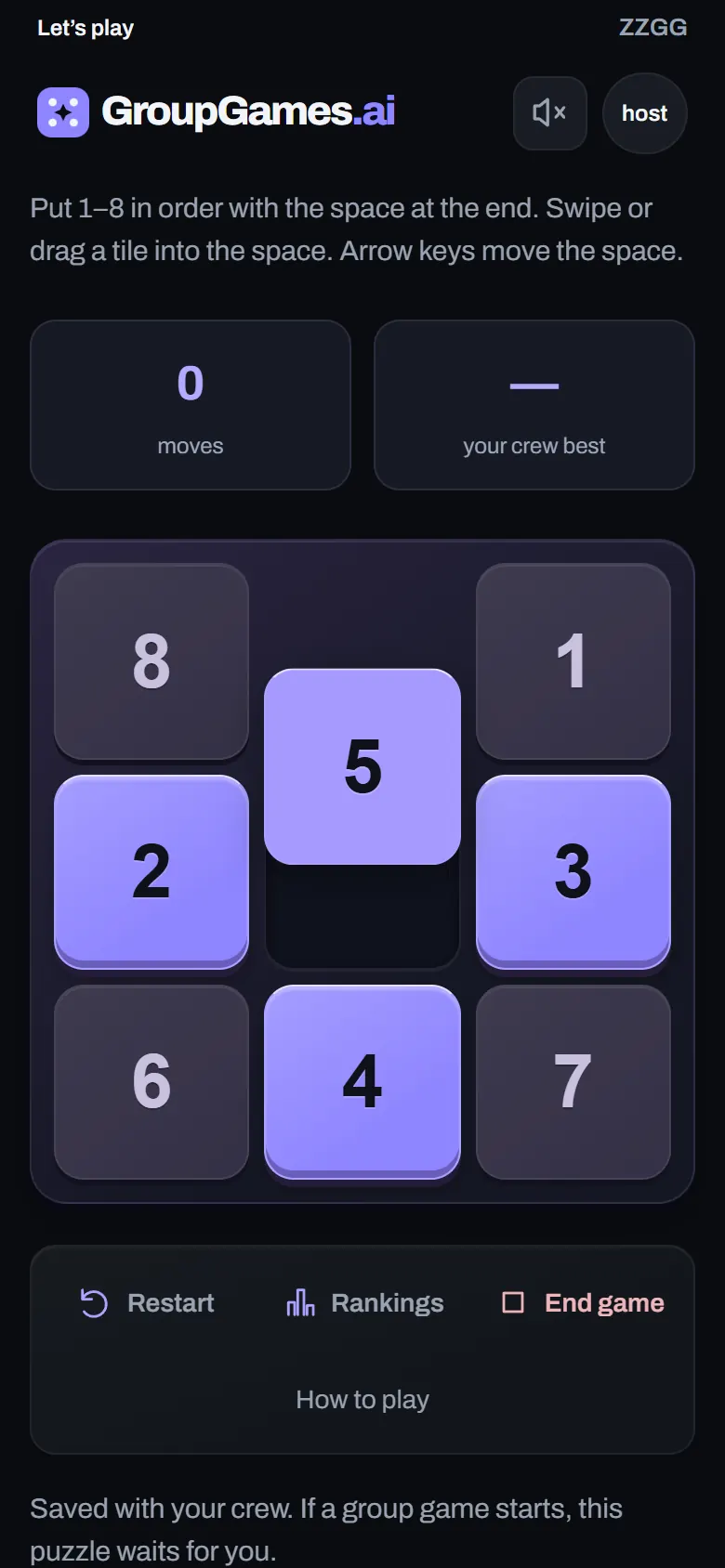
- Feels physical. Tiles follow your finger and snap into place like the plastic puzzle.
- Crew bests. Inside a crew, your finished score goes on the crew leaderboard. Only confirmed finishes count.
- Saves itself. Close the tab mid puzzle and pick up exactly where you left off.
How to solve a sliding puzzle
You do not need to be a genius. Solvers use a simple order:
- Solve the top row first. Get 1, 2 and 3 into place. Tile 3 is the tricky one: bring it below its spot, then rotate it up with the tiles around it.
- Then the left column. Place 4 and 7 in the first column, using the same trick for the last tile.
- Finish the last 2 by 2 block. Tiles 5, 6 and 8 only need to rotate around the space until they line up.
- Never break a finished row. Move the space around solved tiles instead of through them.
Once the method clicks, the challenge becomes doing it in fewer moves. Any 3 by 3 position can be solved in 31 moves or fewer, so there is always room to improve.
Ways to play
Beat your best. Every puzzle is different, so the challenge is to solve each one in fewer moves than your last.
Crew leaderboard. Inside a crew, everyone’s finished scores are ranked together. Each player gets their own shuffle, so it is a friendly contest rather than a race on the same board.
Brain training for kids. Sliding puzzles teach planning ahead. Start children on the top row only, then build up.
Common mistakes
- Solving each tile on its own. Placing 3 straight after 2 usually breaks the row. Set up 3 below its spot first.
- Moving the space through solved tiles. Go around them.
- Giving up at the last block. The final 2 by 2 always solves by rotating tiles around the space.
A short history
The sliding puzzle began with the 15 puzzle, a 4 by 4 box of fifteen tiles invented by Noyes Palmer Chapman, a postmaster in upstate New York, in the 1870s. In 1880 it became a craze across America and Europe. The famous puzzle maker Sam Loyd later claimed he had invented it and offered a large prize for an impossible version, but historians have shown he had nothing to do with its creation. In 1879 two mathematicians proved that exactly half of all starting arrangements can never be solved, which is why a well made puzzle has to be shuffled by moving tiles, not by rearranging them. The 3 by 3 version, often called the 8 puzzle, is now a classic example in computer science.
FAQ
Is every sliding puzzle solvable? No. If tiles are placed at random, half of all arrangements are impossible. Number Slide is always shuffled using legal moves, so every puzzle can be solved.
How can you tell if an 8 puzzle is solvable? Count the pairs of tiles that are in the wrong order relative to each other, ignoring the space. If that number is even, the puzzle can be solved.
What is the fewest number of moves? Every 3 by 3 puzzle can be solved in 31 moves or fewer. Most scrambles need far fewer.
What is the difference between the 8 puzzle and the 15 puzzle? The 8 puzzle is a 3 by 3 board with eight tiles. The 15 puzzle is 4 by 4 with fifteen tiles and is much harder.
Who invented the sliding puzzle? Noyes Palmer Chapman, in the 1870s. The claim by Sam Loyd is a myth.
Do I need an account? No. Play instantly on the solo page. Your progress and best are saved in your browser.
Can I use a keyboard? Yes. Arrow keys move tiles on a computer.